How do you want to shop?
How to Read a Cannabis Label Before You Buy: A Michigan Shopper’s Guide
by Bows Cannabis Dispensary | September 28, 2026
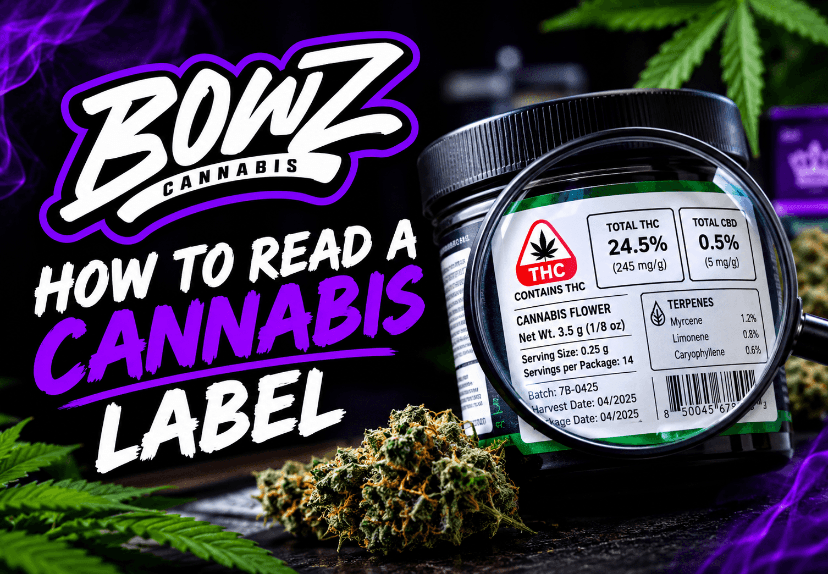
Cannabis labels can look busy at first. You may see THC percentages, package numbers, dates, ingredients, and testing details all in one place. Learning how to read a cannabis label makes it much easier to compare products and know what you are buying.
Michigan also requires specific information on regulated cannabis products. Once you know what to look for, the small print starts to make a lot more sense.
Start With What You're Actually Buying
Before you look at THC, identify the product itself.
Check the:
1. Product type
2. Product or strain name, when applicable
3. Net weight or volume
4. Producer or cultivator
5. Package information
6. Harvest date, when applicable
These details tell you what is inside the package and who made it.
For example, a flower label may show the strain name and net weight. An edible label gives you more information about the product itself, including its ingredients and serving details.
Michigan requires the producer's business name and state license number, along with the package tag assigned through the state's tracking system.
Understand THC, CBD, THCA, and Total THC
THC and CBD are the two cannabinoid numbers you are most likely to see on a Michigan cannabis label.
Michigan requires THC and CBD concentrations reported after laboratory potency testing. The label must also state that the actual value may vary from the reported value by 10%.
You may also see other cannabinoid information. This can include THCA, CBG, or CBN.
Do not treat every number as the same measurement. Read the name next to the number before comparing it with another product.
THC Percentage vs. Milligrams:
Cannabis labels use different units depending on the product.
Flower and concentrates often show THC as a percentage. Edibles, tinctures, and other products may show THC in milligrams.
A percentage tells you about concentration. A milligram amount tells you how much THC is present in a stated amount of product.
For example, 20% THC and 10 mg THC are not equivalent numbers. They describe different things.
Always check the unit before comparing two products.
THC vs. THCA vs. Total THC:
THC, THCA, and Total THC are related, but they are not interchangeable in terms.
THCA is a cannabinoid found in raw cannabis. Heat can convert THCA into THC through decarboxylation.
Some product information may also show a calculated Total THC value. However, Michigan's current general labeling rule specifically requires THC and CBD concentrations. It does not require every package to show a separate THCA or Total THC figure.
So, look at the label heading before deciding what a percentage means.
Check the Serving Size and Package Total
This matters most with edibles, beverages, and other products divided into servings.
A package can contain several servings. The amount listed for one serving may be much smaller than the total amount in the package.
For example, imagine an edible package contains100 mg of THC across 10 equal pieces. The package total is 100 mg. Each piece represents10 mg of the package total.
That example only shows how the numbers work. It is not a recommendation for how muchit is to consume.
When reading the label, look for wording such as:
1. Per serving
2. Per piece
3. Per package
This small detail can prevent a big misunderstanding.
Look Beyond THC: Terpenes and Other Cannabinoids
THC is only one part of a cannabis product.
Some labels or product information also list terpenes. Common examples include myrcene, limonene, caryophyllene, pinene, and linalool.
Terpenes contribute to cannabis aroma and flavor. Their presence can also help you compare the profiles of different products.
You may also see cannabinoids such as CBG or CBN.
Just keep the numbers in context. A terpene or cannabinoid percentage does not guarantee a specific experience. Instead, use this information as another way to understand and compare products.
Check the Dates on the Label
Do not assume every date on a cannabis package means the same thing.
Depending on the product, you may see information related to:
1. Harvest date
2. Production date
3. Testing date
4. Expiration date
A harvest date tells you when applicable cannabis was harvested. A production date relates to when an infused product was made. A testing date tells you when the product was analyzed by a laboratory.
Expiration dates are different. Certain Michigan edible products must carry an expiration date when the product is subject to those requirements.
So, read the label next to the date. Do not treat every date as a freshness date.
Find the Producer, Package, and Testing Information
The smaller print can tell you a lot about where a product came from.
Michigan labels must identify the producer or cultivator and the state license number. They also include the package tag assigned through Michigan's statewide monitoring system. If a different licensed business packaged the product, its information must also appear.
You should also find the name of the laboratory that performed passing compliance testing on the final product. The applicable test analysis date must be listed too.
This information helps connect the product to its regulated package and testing record.
How to Check a COA or QR Code:
A COA is a Certificate of Analysis. It provides laboratory testing information for a product or batch.
If a product provides a COA or a QR code that leads to testing information, compare the details with the package in your hand.
Look for matching product or package information. Check the producer and laboratory details too.
Do not assume every Michigan cannabis product must have a QR code. The current R 420.504 labeling requirements does not list a QR code as a mandatory label element. Michigan has been working through proposed rule changes, but those proposals should not be treated as current requirements.
Check Ingredients and Allergens
Ingredients matter even more when you are buying an infused product.
Michigan requires marijuana infused products to list ingredients, including excipients and diluents, in descending order by weight. The label must also show the product's net weight or volume and production date.
Edible products also have applicable allergen labeling requirements.
So, if you are checking ingredients or avoiding a known allergen, do not stop at the front of the package. Turn it over and read the ingredient panel.
Know the Michigan Symbol and Required Warnings
Michigan cannabis labels include required compliance and safety information.
Look for the Michigan universal marijuana product symbol. The CRA says the symbol must be affixed where required by Michigan's administrative rules.
Labels also include required warnings. These cover driving under the influence, the National Poison Control Center number, keeping cannabis away from children, age or patient restrictions, and pregnancy or breastfeeding warnings.
You may also see activation time written out or shown with a pictogram.
These details may look like fine print. They are still part of the information you should check before buying.
What a Cannabis Label Can and Can't Tell You
A label can tell you a lot.
It can show you the product type, quantity, cannabinoid information, ingredients, dates, producer, package information, testing laboratory, and required warnings.
It cannot tell you exactly how you will experience the product.
That is why the highest THC number should not be your only comparison point. Look at the full label and consider the product format, cannabinoid information, ingredients, dates, and other details.
If something does not make sense, ask the licensed retailer to explain it. You do not have to guess what an unfamiliar number or abbreviation means.
A Quick Cannabis Label Check Before You Buy
You do not need to study every line of a label.
Run through these five checks:
1. What am I buying? Check the product type, name, and quantity.
2. What are the cannabinoid numbers? Check THC, CBD, and any other listed cannabinoids.
3. How is the amount measured? Look for percentage, milligrams, serving, or package information.
4. When was it made or tested? Read each date based on its label description.
5. Who made and tested it? Check the producer, package information, and testing laboratory.
Then check the ingredients and require warnings when they apply.
Once you know where to look, a cannabis label becomes much easier to understand. Instead of choosing based only on the biggest number or the package design, you can compare the information that actually describes the product.
Shop Cannabis at BOWZ Cannabis
Now that you know what to look for on a cannabis label, you can compare products with more confidence. Explore BOWZ Cannabis to browse available cannabis products, check product details, and find a dispensary near you.
BOWZ Cannabis serves Michigan shoppers at locations in Luna Pier and Riverview. Visit Bowz Luna Pier at 10501 Evans Drive or Bowz Riverview at 15600 King Road.
Frequently Asked Questions About Cannabis Labels
Are cannabis labels the same in every state?
Answer: No. Cannabis labeling rules vary by state. Michigan has its own requirements for information such as cannabinoid concentrations, package details, testing information, and required warnings.
Why does a flower show THC as a percentage while edibles use milligrams?
Answer: The units describe different measurements. THC percentages show concentration, which is common for flower and concentrates. Milligrams show an amount of THC and are commonly used for edibles and other products with defined servings.
Does higher THC mean better cannabis?
Answer: Not necessarily. THC is one product characteristic, not a quality score. You can also compare the product type, cannabinoid information, terpene profile, ingredients, quantity, and other label details.
Does having more terpenes mean a better high?
Answer: Not necessarily. A higher terpene amount does not automatically mean a stronger or better experience. Terpenes contribute to a product's aroma and flavor, but their amount alone cannot predict exactly how a product will feel.
Is a QR code required on every cannabis product in Michigan?
Answer: No. Michigan's current labeling requirements do not require every cannabis package to have a QR code. Some products may still provide one for additional information, such as laboratory testing results.
Michigan Cannabis Legal Disclaimer:
Answer: Cannabis laws and regulations can change. This information is for educational purposes and does not constitute legal or medical advice. Always follow current Michigan Cannabis Regulatory Agency rules and applicable state and local laws when purchasing, possessing, or using cannabis.