How do you want to shop?
THC vs THCA: What Do the Numbers on Flower Labels Mean?

by Bows Cannabis Dispensary | September 28, 2026
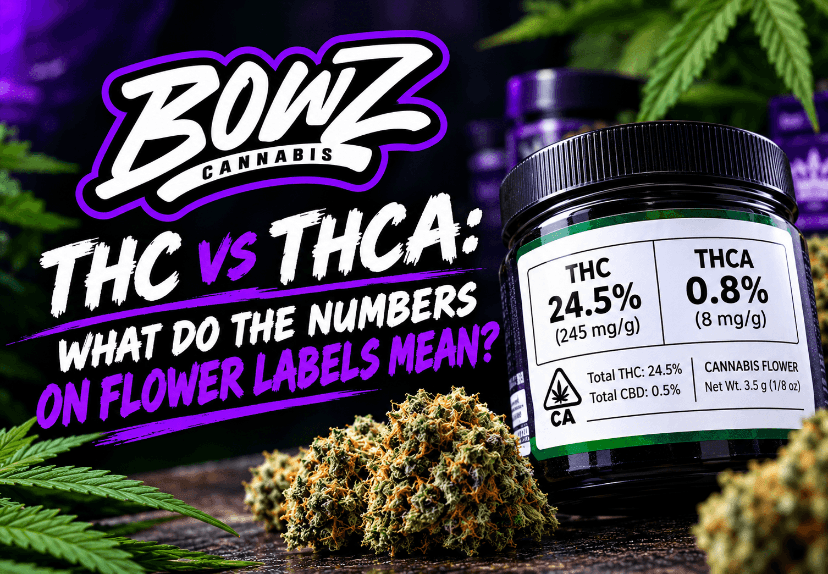
Cannabis flower labels can show several THC related numbers at once. You might see THCA, delta 9 THC, and Total THC, each with a different percentage. If those numbers look confusing, you are not alone.
The simple answer is this: THCA and THC are related, but they are not the same thing. THCA is the acidic form found naturally in cannabis flower. Heat can convert THCA into delta 9 THC. Total THC is a calculated value that accounts for both.
Here is how to read those numbers without getting lost in the chemistry.
THC vs THCA: What's the Difference?
THCA stands for tetrahydrocannabinol acid. It is one of the main cannabinoids naturally found in fresh cannabis flower.
Delta 9 THC is the neutral form of THC. It is the cannabinoid associated with the intoxicating effects of cannabis.
So why does a flower label often show much more THCA than THC?
Because cannabis plants naturally produce cannabinoids in their acidic forms. Michigan's Cannabis Regulatory Agency also explains that cannabis flower contains primarily THCA rather than delta 9 THC before heating.
That is why you might see a label with 25% THCA and only 0.5% delta 9 THC. The two numbers are describing different forms of the cannabinoid.
Why Does Cannabis Flower Have More THCA Than THC?
Cannabis flower does not start out with all of its THC in the form you might expect.
Much of it exists as THCA. When THCA is heated, it goes through a chemical process called decarboxylation. This changes THCA into delta 9 THC.
Smoking and vaporizing expose flower to heat, so decarboxylation happens during those processes.
The conversion is not perfectly predictable, though. Temperature, heating time, and other conditions can affect how much THCA converts to THC. So, the THCA number on a label should not be treated as a promise of exactly how much THC your body will receive.
What Does Total THC Mean on a Flower Label?
Total THC is a calculated measurement. It is not another cannabinoid sitting separately in the flower.
It accounts for the delta 9 THC already present and the potential THC represented by the THCA.
Michigan's potency testing rules use this calculation:
Total THC = THC + (THCA × 0.877)
For flower and concentrates, Michigan requires Total THC to be reported as a percentage.
The 0.877 factor matters because THCA does not convert into an equal amount of THC by weight.
Why Is THCA Multiplied by 0.877?
When THCA converts into THC, it loses a carboxyl group during decarboxylation.
That loss changes the molecular weight. As a result, 1 gram of THCA does not become 1 gram of THC.
The 0.877 factor accounts for this difference. Michigan uses the same factor in its Total THC calculation.
You do not need to remember the chemistry behind it. Just know that you cannot add the THCA and THC percentages together and call the result Total THC.
How to Calculate Total THC From a Flower Label
Let's use a simple label example.
Imagine the flower shows:
THCA: 25%
Delta 9 THC: 0.5%
First, multiply the THCA percentage by 0.877:
25 × 0.877 = 21.925
Then add the delta 9 THC:
21.925 + 0.5 = 22.425%
So, the calculated Total THC is about 22.4%.
Here is what each number tells you:
Label number | What it means |
25% THCA | THCA measured in the tested flower |
0.5% THC | Delta 9 THC already present |
22.4% Total THC | Calculated THC value using the conversion formula |
Notice something important. You did not add 25% and 0.5% to get 25.5% Total THC.
The THCA amount is first adjusted using the 0.877 factor.
Does Higher THCA Mean Stronger Flower?
A higher THCA percentage generally means more THCA is available for potential conversion into THC, assuming other factors are similar.
But that does not make THCA a complete measure of the flower.
Your experience can also depend on the product's cannabinoid profile, terpene profile, how you consume it, and your own response to cannabis.
So, do not treat the biggest THCA number as a quality score.
A label gives you useful information. It does not tell you everything about the flowers.
Total THC vs. Total Cannabinoids: What's the Difference?
These two terms sound similar, but they describe different things.
Total THC focuses on THC related measurements. It accounts for measured THC and the potential THC represented by THCA.
Total Cannabinoids can include a much wider group of cannabinoids.
Depending on the product or laboratory report, you may see cannabinoids such as:
1. CBD
2. CBDA
3. CBG
4. CBN
5. THCA
6. Delta 9 THC
So, if you see Total Cannabinoids on a label or COA, do not assume it means Total THC.
Always check the heading next to the percentage.
Why Can the Same Strain Have Different THC or THCA Percentages?
You may notice that the same strain name has different THC or THCA numbers across products.
That is normal.
Cannabis is an agricultural product. Different batches can vary because of growing conditions, harvest timing, processing, storage, and natural plant variation.
Testing also applies to a specific batch. So, the laboratory result tells you about the sample that was tested. It does not mean every batch with the same strain name will have the same cannabinoid profile.
That is why current batch information is more useful than relying on a strain name alone.
What Does a COA Tell You About THC and THCA?
A Certificate of Analysis, or COA, is a laboratory report for a tested cannabis product or batch.
A COA can give you more details than the package label. Depending on the report, you may see individual cannabinoid results, Total THC, Total CBD, and safety testing information.
Michigan requires regulated cannabis laboratories to perform required potency and safety testing. Its testing rules include Total THC and THC A in potency analysis.
The batch information matters too. A COA is tied to the product or batch tested, so make sure the information matches the product you are checking.
If a product provides a COA, use it as a deeper look at the laboratory results rather than treating it as a replacement for the package label.
What Should You Look at When Comparing Flower?
THC and THCA numbers are useful. They just should not be the only things you check.
When comparing flowers, look at the full product information.
Pay attention to:
1. Total THC
2. THCA and delta 9 THC
3. Other listed cannabinoids
4. Terpene information
5. Strain or cultivar
6. Product weight
7. Batch and testing information
Then think about what you actually want from the product.
A flower with the highest THCA percentage is not automatically the right choice for you. The label gives you several pieces of information. Use them together instead of letting one number make the entire decision.
The more you understand THC vs THCA, the easier it becomes to read a flower label without getting distracted by the biggest percentage.
Shop at BOWZ Cannabis
Now that you know how THC, THCA, and Total THC work, you can read flower labels with more confidence. Compare the numbers, check the cannabinoid and terpene profile, and look at the product testing information before you buy them.
Browse Cannabis Flower at BOWZ Cannabis and explore products available at our Michigan locations in Luna Pier and Riverview.
Frequently Asked Questions About THC and THCA
Is THCA Flower Different From Regular Cannabis Flower?
Answer: Not necessarily. THCA is naturally present in cannabis flower, so most cannabis flower contains THCA before it is heated. The main difference is how the product is marketed and labeled. If a product is sold as “THCA flower,” check the label and testing information to see how much THCA and THC it actually contains.
Why Can the Same Strain Have Different THC Percentages?
Answer: The same strain can test differently from one batch to another. Growing conditions, harvest timing, processing, storage, and natural plant variation can all affect cannabinoid levels. Lab testing can also show differences between batches. That is why it is better to check the label for the specific batch you are buying.
Can THC and THCA Numbers Change as Flower Ages?
Answer: Yes. Cannabis can change over time, especially if it is exposed to heat, light, air, or moisture. Some THCA can gradually convert into THC and, with further degradation, other compounds. Proper storage can help slow these changes and preserve the flower's cannabinoid profile.
Does Higher THCA Mean Better Cannabis?
Answer: Not necessarily. A higher THCA percentage means the flower has more THCA available to convert into THC when heated, but it does not tell you everything about the product.
Disclaimer:This article is for informational and educational purposes only. It is not intended to provide medical or legal advice. Cannabis laws and regulations can change, so always check current Michigan rules before making decisions about cannabis.